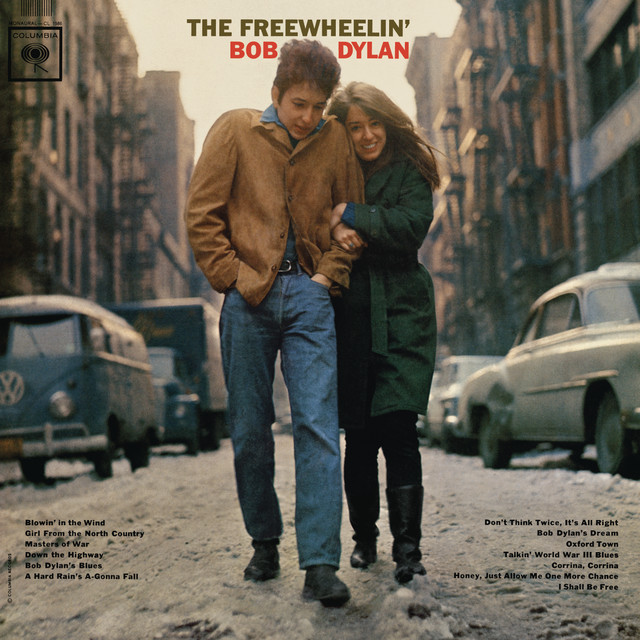
- Album
- The Freewheelin' Bob Dylan
- Released
- May 27, 1963
- Added to Lately
- Dec 2022
- Recorded at
- Columbia Studio A (Columbia Recording Studios, 799 Seventh Avenue), New York City
- Runtime
- 4:38
- Sounds like
- folk · protest song · american folk revival · bob-dylan · protest-song · american-folk-revival · 1963
The last thing the narrator of Masters of War promises is a graveside vigil. He’ll follow the casket, watch it lowered, and stand there “‘Til I’m sure that you’re dead.” It’s one of the coldest closing lines in American song. In the Freewheelin’ liner notes Bob Dylan said he’d never written anything like it, that he doesn’t sing songs hoping people will die, but with this one he couldn’t help it. He called it a reaction to the last straw.
That admission matters, because the fury here is only the surface. Read the song verse by verse and fear keeps showing through. The men who build the big guns and death planes never appear on the battlefield. They put the gun in someone else’s hand and run when the bullets fly. The narrator is the one holding that gun, or expecting to. Then the song turns from the young dying in the mud to children who haven’t been born yet: “Fear to bring children / Into the world.” His own baby comes up next, unborn and unnamed. That’s where the anger comes from: the threat to the life he hasn’t started yet.
There’s insecurity in it too. Later, he answers the critics in his head, the ones who’d call him young and unlearned, and he settles the argument by saying even Jesus wouldn’t forgive these men. He claims a moral certainty that he then uses to refuse forgiveness himself. The song never squares that, and it’s stronger for leaving it alone. In a 2001 interview Dylan said it isn’t an anti-war song. The lyric bears him out. It isn’t pleading for peace. It’s an accusation aimed at the people who profit from war.
The sound gives the anger no cover. A fingerpicked acoustic guitar holds a steady, unhurried pattern, and the room sounds small and dry. Dylan’s voice is slightly raspy, plain, and direct, with no harmonies and nothing added.
The tune is old. Dylan took the melody from the traditional “Nottamun Town,” borrowing the arrangement from Jean Ritchie’s family version. That was how Freewheelin’ worked. On his second album he wrote 12 of the 13 songs and pushed further at setting new words to traditional melodies. Late in the sessions he told friends the record needed more “finger-pointin’” songs, and this was the first result. It was cut in April 1963 with John H. Hammond producing. Dylan did six takes, and the third is the one on the album. He wouldn’t play it acoustic again for 30 years, until a 1994 concert in Hiroshima.
What stays with you is how calm the music is under all that rage, a voice keeping steady while it says something it can’t take back.
[ Sources ]
- Wikipedia: Masters of War
- Wikipedia: The Freewheelin' Bob Dylan
- Songfacts: Masters Of War by Bob Dylan
- American Songwriter: The 30 Greatest Bob Dylan Songs: #8, "Masters of War"
- Rolling Stone India: 'The Freewheelin' Bob Dylan': Inside His First Classic
- Untold Dylan: How Bob Dylan became a poet first and a songwriter second: “Masters of War”
[ Written with AI assistance · the taste is all mine ]